Notes
Class 7-General Science - Chapter -9-Heat
Topics to be Learn:
|
Introduction :
Heat is a form of energy. We feel its effects every day: food cooks, ice melts, a hot cup of tea turns cool, and the Sun warms the Earth.
Heat : Heat is a form of energy that flows from a hotter object to a colder object and produces effects such as a rise in temperature, change of state and expansion.
- Heat can cause changes in the state of matter (solid, liquid, gas), which we have already studied.
- The Sun is our main natural source of heat.
Transfer of Heat :
Transfer of heat : The flow of heat from one place to another is called transfer of heat.
- When a hot object is brought near a cold object, the cold object becomes warm and the hot object becomes cooler. Therefore, heat is transferred from a hot body to a cold body.
- Heat always flows from higher temperature to lower temperature. The flow continues until both bodies reach the same temperature.
Modes of Heat Transfer :
Heat is transferred in three ways: conduction, convection and radiation.
(1) Conduction : The transfer of heat from the hot part of an object to its cold part, through the object itself, is called conduction of heat.
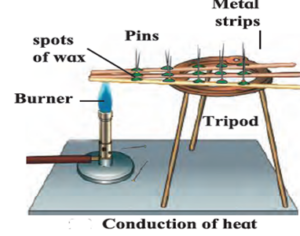
- Heat moves from the hot end to the cold end of the bar.
- How fast heat is conducted depends on the property of the substance. Copper conducts heat quickly.
- Conduction occurs through a solid, which shows a medium is required for conduction.
(2) Convection : The transfer of heat by means of currents (convection currents) in a liquid or a gas is called convection of heat.
- Convection can occur in liquid and gaseous substances.
- Convection needs a medium.
- It cannot occur in solids.
(3) Radiation : The transfer of heat without the need of any medium is called radiation.
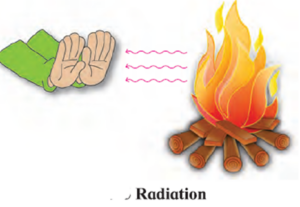
- In the examples above (bonfire), heat reaches us mainly by radiation.
- The heat from the Sun travels millions of kilometers through the vacuum of space to reach the Earth entirely by radiation.
| Know This : Infrared camera
Many objects in nature (trees, mountains, stones, roads) radiate heat. An infrared camera uses these radiations to make surroundings visible at night, so it can be used to watch the movements of the enemy during the night. |
Absorption and Reflection of Heat Radiation :
When heat rays fall on an object, a part is absorbed by the object and a part is reflected.
The ability of a substance to absorb heat radiation depends on its colour and also on its intrinsic properties.
- Black and Dark-Coloured Surfaces: Absorb maximum heat radiation. Hence, dark clothes are worn in winter, and solar water heater panels are painted black.
- White and Light-Coloured Surfaces: Reflect most of the heat radiation. Hence, white clothes are worn in summer, and houses in hot regions like Rajasthan are painted white.
Comparison of the Three Modes
| Feature | Conduction | Convection | Radiation |
| Medium needed? | Yes (solid) | Yes (liquid or gas) | No |
| How heat moves | Hot part to cold part through the substance | By convection currents (warm rises, cold sinks) | Heat rays travel directly |
| Where it occurs | Mainly solids | Liquids and gases | Any place, even a vacuum |
| Example | Spoon heating in hot milk; pins falling from a bar | Heating water in a beaker; sea breeze | Warmth from the Sun or a bonfire |
| Experiment | Wax spots and pins on bars | KMnO₄ crystals in water | Hands near a candle |
Good and Bad Conductors of Heat :
Good conductor : A substance through which heat flows easily (e.g. copper, steel, aluminium, iron).
Bad conductor (insulator) : A substance through which heat does not flow easily (e.g. plastic, wood, glass, air).
- Some substances are good conductors of heat while some are bad conductors. Heat is easily conducted through a copper strip or pot, but not through plastic or wood.
- We can hold a glass tumbler or china cup full of hot tea easily, but not a steel or copper cup with the same tea, because steel and copper are good conductors and glass and china are bad conductors.
| Good conductors | Bad conductors | Everyday use |
| Copper, steel, aluminium, iron | Plastic, wood, glass, china, cloth | Cooking vessels are metal (heat passes quickly to food); their handles are plastic or wood (heat does not reach the hand). |
Expansion and Contraction Due to Heat :
Expansion and contraction :
Expansion: increase in size (length, area or volume) of a substance when heated.
Contraction: decrease in size of a substance when it cools.
(1) Solids :
- Metals expand on heating and contract on cooling.
- Solids expand due to heat and come back to the original state if heat is removed.
- The extent of expansion is different for different solids.
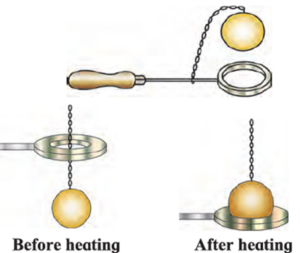
Why is there a gap at joints of rails and cement concrete bridges?
- Rails and bridges expand in summer heat. The gap gives room for expansion, so they do not bend or crack. Without the gap, the expanding rail would buckle.
(2) Liquids :
When a liquid is heated, the distances between its particles increase and its volume increases. This is expansion of liquids. When its temperature falls, the liquid contracts.
- Mercury and alcohol expand regularly and visibly when temperature rises, so the level in the thin tube shows the temperature clearly. They are liquids that show a clear, measurable rise even for small temperature changes.
(3) Gases :
The volume of a gas increases on heating (expansion). On removing heat, the volume decreases (contraction).
| State | Effect of heating | Effect of cooling | Example |
| Solid | Expands (a little) | Contracts | Metal ball and ring; rail gaps; telephone wires |
| Liquid | Expands (more than solids) | Contracts | Water level in tube; thermometer liquid |
| Gas | Expands (a lot) | Contracts | Balloon on a bottle in hot water |
In general, gases expand the most and solids the least for the same rise in temperature.
Thermos Flask (Dewar Flask)
A thermos flask keeps tea, coffee or milk hot, or sherbet cold, for a long time.
Structure (Fig )
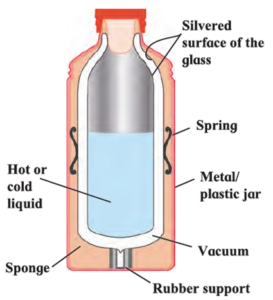
- A double-walled flask: two glass tubes, one inside the other, with the gap between them sealed.
- The surfaces of both tubes are made shiny with a silver coating.
- The air between the two tubes is removed to create a vacuum.
- A protective jar of metal or plastic is outside the tubes.
- Sponge or rubber pieces are fixed between the outer jar and the flask to protect it.
| Part (as labelled in Fig) | Purpose |
| Silvered surface of the glass | Reflects heat back; prevents loss/gain by radiation |
| Vacuum | No particles, so no conduction and no convection |
| Hot or cold liquid | Contents kept at their temperature |
| Spring, sponge, rubber support | Cushion the glass flask against shocks |
| Metal / plastic jar | Outer protective cover |
Function :
How a thermos keeps liquids hot :
| Structural Feature | Design Description | Heat Transfer Mode Prevented |
| Silvered Glass Surfaces | Inner surfaces of the double-walled glass tube are polished to a shining silver finish. | Prevents Radiation: Shining surface reflects outgoing heat back into the flask and incoming heat away. |
| Vacuum between Walls | Air is removed from the space between the double glass walls, creating a vacuum. | Prevents Conduction & Convection: With no medium (air molecules), heat cannot flow by conduction or convection. |
| Insulated Outer Jar & Cap | Encased in a plastic/metal jar supported by rubber/sponge base with a cork/plastic lid. | Minimizes Residual Conduction: Plastic/cork materials are bad conductors, preventing small heat loss at the rim. |
A cold liquid stays cold for the same reasons: outside heat cannot get in.
Why not forever?
A little heat is still lost around the lid and by a small amount of conduction through the glass. Therefore a hot substance does not remain hot after two or three hours.
| Know This : Great Scientist: Sir James Dewar :
Sir James Dewar was a Scottish scientist. He made the first thermos flask in 1892, so it is called a Dewar flask. Even today a Dewar flask is used to keep a substance cold or hot. |
Thermoware : Thermoware means containers and utensils with heat-insulating walls (such as insulated casseroles, hot-pots, lunch boxes and flasks) used to keep food and drinks hot or cold for a long time, working on the same idea as a thermos flask.
This is very helpful to me my brother ask me this type of question
I appreciate your work brooda… 😊
Excellent…💯